Archive for the ‘Nagarjuna’ Category

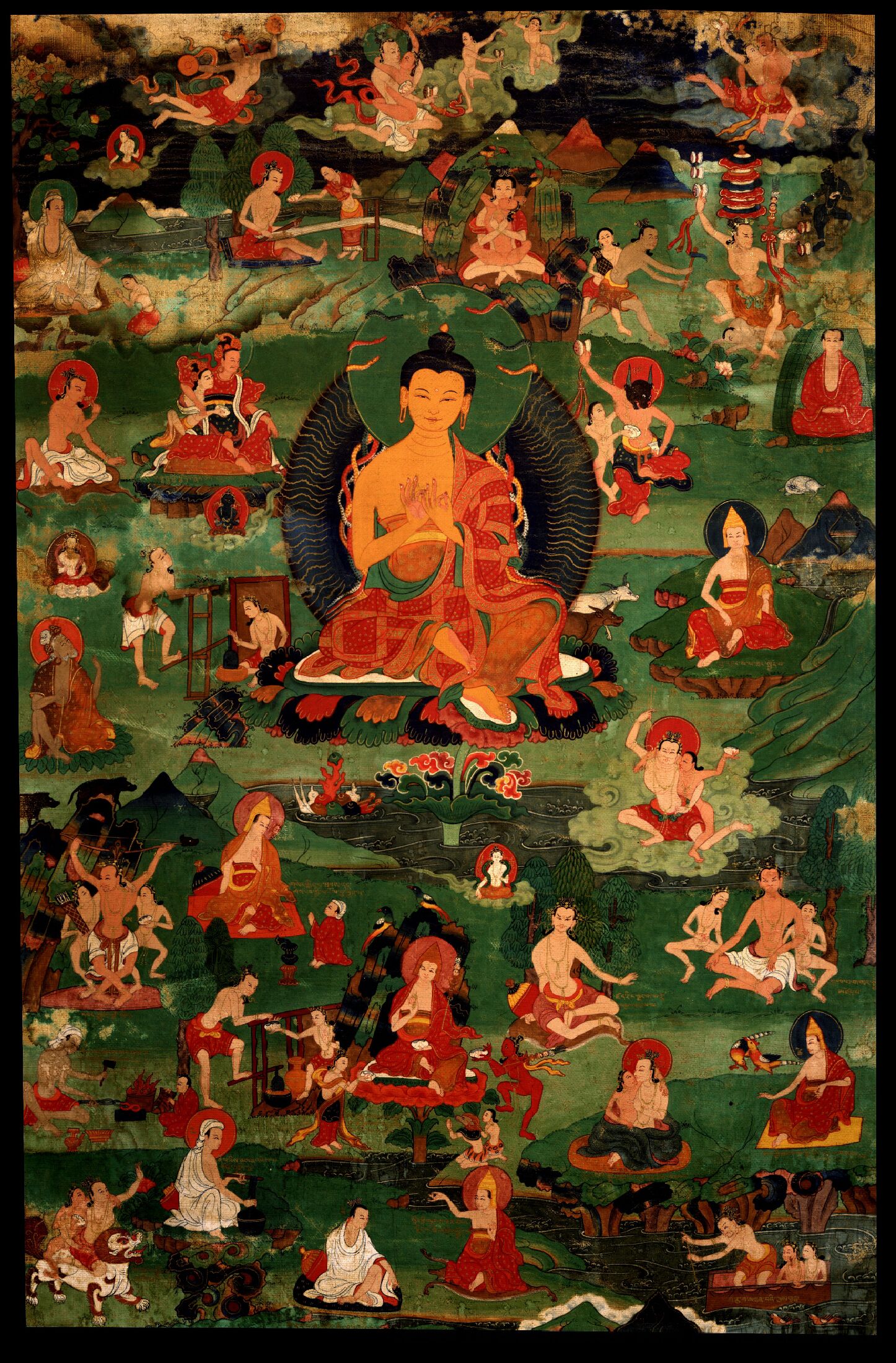
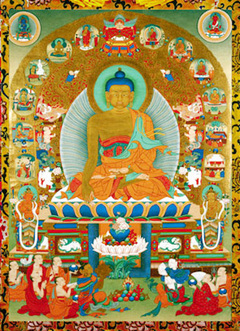
Nagarjuna: Le 12 Azioni del Buddha

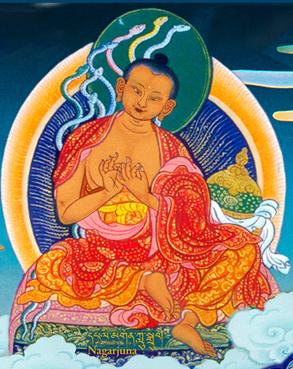
Nagarjuna

Ossequi a Te, Re dei Sakya, il cui corpo risplende come una montagna d’oro; a Te che, colmo di compassione e abilità nel metodo dell’insegnamento, prendesti nascita nella stirpe dei Sakya e domasti gli eserciti del male che altri non potevano debellare.

Ossequi a Te, Re dei Sakya, il cui corpo risplende come una montagna d’oro; a Te che, colmo di compassione e abilità nel metodo dell’insegnamento, prendesti nascita nella stirpe dei Sakya e domasti gli eserciti del male che altri non potevano debellare.

Lode a Te, che per raggiungere l’Illuminazione risvegliasti dapprima Bodhicitta quindi accumulasti perfettamente i meriti e la saggezza trascendentale poiché, grazie alle Tue smisurate azioni, desideravi diventare in questa epoca il protettore degli esseri.

1.

Ossequi a Te, reggente degli dei; avendo capito che era tempo di esibire l’autodisciplina scendesti dal cielo; sotto forma di elefante Ti recasti nella famiglia prescelta ed entrasti nel grembo di Mayadevi.

2.

Ossequi a Te, figlio dei Sakya; dieci mesi dopo la nascita nel bosco di Lumbini, Brahma e Indra resero omaggio a Te, i cui nobili segni mostravano con certezza che appartenevi alla razza degli esseri illuminati. LEGGI TUTTO … Read the rest of this entry »


Nagarjuna: Exposition of Bodhicitta, Bodhicittavivarana

NagarjunaNagarjuna: Exposition of Bodhicitta Bodhicittavivarana (a critique of Vijnanavada)

NNIntroduction

This regrettably neglected text comprises 112 stanzas introduced by a brief prologue in prose. It has sometimes been grouped as a tantric work, but a glance at its contents shows how unwarranted such a classification is.

The Bodhicittavivarana is never mentioned or cited by Buddhapalita or Candrakirti. On the other hand it forms one of the basic authorities for Bhavya in his most mature work, the Ratnapradipa. It is never quoted in his earlier works, the Tarkajvala, Prajnapradipa, and [*Kara-]talaratna. Among other ‘good’ authors citing the Bodhicittavivarana are especially Asvabhava and Santaraksita. I have also come across scores of quotations by other commentators; fortunately several of these are in Sanskrit. It is my general impression that the Yuktisastika, Catuhstava, and Bodhicittavivarana are the most frequently quoted among all works ascribed to Nagarjuna in later Indian literature. Read the rest of this entry »


Nagarjuna: The Accumulations for Enlightenment Bodhisambharaka

1.
Now, in the presence of the Buddhas, I fold my hands and bow
my head. I intend to explain according to tradition a Buddha’s
accumulations for enlightenment.

2.
How is it possible to explain without omission the
accumulations for enlightenment? [For] the Buddhas are the
only ones who individually obtain infinite enlightenment!

3.
The body of a Buddha has infinite qualities. The [two]
accumulations for enlightenment constitute the basis.
Therefore the accumulations for enlightenment have no final
limit either. Read the rest of this entry »


Nagarjuna: Letter to a Friend

Nagarjuna (1st – 2nd century CE), the great Indian Buddhist master, wrote this letter of advice, in verse, to a king that was a friend. Although short at only 123 verses, it is considered to be a monument in the Indian Buddhist tradition, and covers the Mahayana path with uncommon clarity, and is for this reason much quoted by many great Tibetan masters.

Letter to a Friend

(bShes-pa’i springs-yig, Skt. Suhrllekha)
by Nagarjuna

translated by Alexander Berzin, March 2006

(1) O you, with a nature of good qualities, who’ve become worthy
through constructive deeds,
Please listen to these (verses) in noble meter,
Which I’ve compiled in short for the sake of (instilling)
An intention for the positive force that comes from (following)
explanations of the Blissfully Gone (Buddha’s) speech.

(2) Just as the wise venerate a statue of the Blissfully Gone,
Even out of wood, regardless of how it’s been made;
Likewise, although this poetry of mine may be deficient,
please do not scorn it,
Since it’s based on expressions of the hallowed Dharma. Read the rest of this entry »


Nagarjuna: In Praise of the Transcendental

Nagarjuna: In Praise of the Transcendental

HYMN TO [THE BUDDHA,] THE WORLD TRANSCENDENT by Nagarjuna

Sanskrit title: Lokatistava

Tibetan title: ‘jig rten las ‘das par bstod pa (jigten ley depar toepa)

Homage to Manjushri!

1

I bow to you, the world transcendent,

You who’re versed in the gnosis of absence.

For the benefit of the world

You’ve suffered long with great compassion.

2

That apart from the mere aggregates

No sentient being exists, you uphold.

Yet, great sage, you continue to remain

Perfectly immersed in the welfare of beings. Read the rest of this entry »


Nāgārjuna: Root Stanzas on the Middle Way

Ārya Nāgārjuna

Root Stanzas on the Middle Way

Sanskrit: Mula madhyamaka karika.

Tibetan: dBu ma rtsa ba’i tshig le’ur byas pa shes rab ces bya ba.

[Translator’s homage]

dBu ma rtsa ba’i tshig le’ur byas pa Shes rab ces bya ba bzhugs so // //

rgya gar skad du // Pra dzny’a n’a ma m’u la ma dhy’a ma ka k’a ri ka

bod skad du //’jam dpal gzhon nur gyur pa la phyag ‘tshal lo

Here lie the Root Verses of the Center called “Intelligence”. In the language of India: Prajnanamamulamadhyamakakarika. In the language of Tibet: dBu ma rtsa ba’i tshig le’ur byas pa shes rab ces bya ba. I prostrate to the youthful Manjushri. Read the rest of this entry »


Nagarjuna: The Precious Garland, Ratnavali

The Precious Garland, Ratnavali by Arya Nagarjuna

Homage to all Buddhas and Bodhisattvas.

No. 1.
I bow down to the Omniscient,
Freed from all defects,
Adorned with all good qualities,
The sole friend of all beings.

No. 2.
O King, I will explain practices solely virtuous
To generate in you the doctrine,
For the practices will be established
In a vessel of the excellent doctrine.

No. 3.
In one who first practices high status
Definite goodness arises later,
For having attained high status,
One comes gradually to definite goodness. Read the rest of this entry »


Nagarjuna: The Heart of Interdependent Origination

The Heart of Interdependent Origination

Nagarjuna’s Commentary to The Heart of Interdependent Origination

An Introduction to Nagarjuna’s Heart of Interdependent Origination

All Buddhist schools have denied the existence of the self as an identical permanent and immutable substance which experiences the results of former actions. They have also universally rejected the notion of a supreme god. They have however accepted the relative reality of pre-existence and subsequent rebirth as well as the provisional efficiency of actions (Karma). Those who adhere to the doctrine of the self have opposed this view, because as they contend, denial of an identical permanent and immutable self controverts the efficiency of actions and the doctrine of rebirth. The Buddhist schools have replied to this objection with the doctrine of Interdependent Origination. The doctrine of Interdependent Origination has been expounded at length by the Buddha in numerous discourses, most notably in the Salistambasutra (1) wherein the famous and often cited example of the Interdependent Origination of the sprout appears. Read the rest of this entry »


Nagarjuna: In praise of the Dharmadhatu

IN PRAISE OF THE DHARMADHATU

by Arya Nagarjuna

1. There is something which as long as left unknown

Results in life’s three planes of vicious circle.

Beyond all doubt, it dwells in every being.

To the dharmadhatu I devoutly bow. Read the rest of this entry »


Nagarjuna: Sixty stanzas of reasoning

SIXTY STANZAS OF REASONING

Nagarjuna

Sanskrit title: Yuktisastika-karika

Tibetan title: rigs pa drug cu pa

Homage to the youthful Manjushri.

Homage to the great Sage

Who taught dependent origination,

The means by which are eliminated

Arising and destruction. Read the rest of this entry »