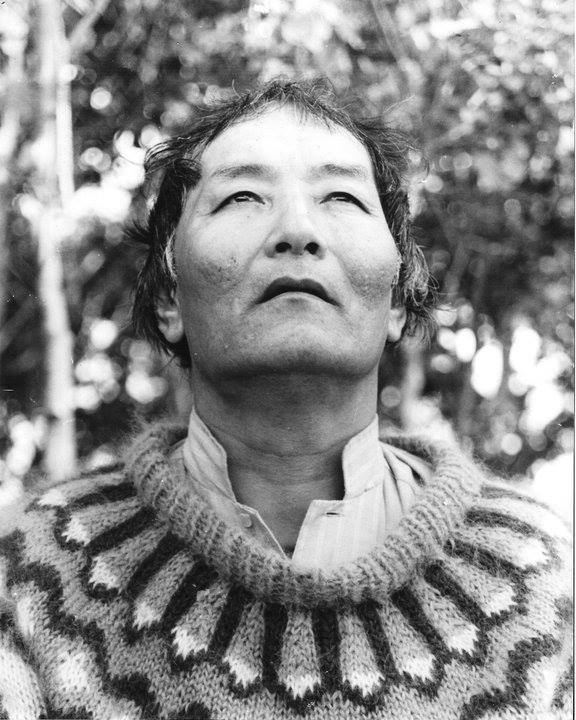
Chogyal Namkhai Norbu: If we see a five coloured rainbow, this means that we perceive the pure dimension, pure vision.
Chogyal Namkhai Norbu: Tsal, Rolpa, And Dang
The energy of the Base manifests as Tsal, Rolpa, and Dang.
Why does this energy have these three aspects?
In relation to realisation there are the three Kayas, the Dharmakaya, Sambhogakaya, and Nirmanakaya.
The three kayas are related to the three aspects of our condition:
Essence,
Nature,
Energy.
The Essence is emptiness, and knowledge of that is the Dharmakaya of the Base.
Dharmakaya, Sambhogakaya, and Nirmanakaya are not only qualities of the Buddha ; they are also the potentiality of every individual.
How can one discover and understand this for ourselves?
We observe ourselves. When you discover your Essence, it means you discover the Dharmakaya of your Base.
When you discover your Nature, your clarity, then you discover the Sambhogakaya of your Base.
When you discover the uninterrupted continuity of your Energy, you discover the Nirmanakaya of your Base.
We have these attributes.
Energy manifests in three different ways as Dharmakaya, Sambhogakaya, and Nirmanakaya.
The Dharmakaya aspect is called the Dang energy.Dang means that in a state of contemplation, our real condition of the Base, our Energy, manifests in the way a crystal ball does.
If a crystal ball is placed on a red surface, it appears red, while on a green surface, it appears green, and so on, but in fact its basic condition never changes.
That is how the Energy called Dang manifests.
When we are in a state of contemplation, in whatever circumstances we find ourselves, we are integrated into the state of contemplation.
We do not remain apart, thinking that we are in contemplation, and that we do not care about circumstances.
Circumstances are integrated, like the example of the crystal ball.
That is how Dang Energy manifests.
The example of the mirror is used to explain the aspect of Energy called Rolpa.
Whatever is in front of a mirror, whether good or bad, is immediately reflected in it.
The practioner is not conditioned by what appears in the mirror because he or she understands that whatever appears is only a reflection.
Whether the reflections are good or bad is not important because, at the level of the profound meaning, there is no difference between good and bad.
The reflections only manifest because of the natural capacity of our condition to reflect.
Everything manifests just as it is, colour, form, shape, size, anything can appear.
That is the characteristic manifestation of the aspect of Energy called Rolpa.
Another manifestation of Energy is called Tsal which is related to the Nirmanakaya condition.
The example used in this case is a piece of rock crystal that is struck by the sun’s rays.
Infinite rainbow colours emanate from such a rock crystal onto the walls of a room in which it is placed, but if you look into the rock crystal you cannot see these rainbows inside it ; they are only visible outside.
This is the aspect of Energy called Tsal.
It is through this Tsal Energy that our manifestation of pure and impure vision, and our particular karmic visions arise.
We are now human beings, and we have human vision.
We perceive our environment dualistically, splitting it into an apparent reality of a perceiving subject separated from a world of external objects.
But in fact everything we perceive is like the rainbow lights, which have their source in the rock crystal when it is struck by the sun’s rays.
If we see a five coloured rainbow, this means that we perceive the pure dimension, pure vision.
When the essence of the elements combines together with our karma, then the elements manifest on the material level, creating impure vision.
Thus, the source of karmic vision is this aspect of Energy known as Tsal; but this same Tsal Energy, through certain practices particularly in the Dzogchen teaching, such as Thodgal and Yangti, gives us the possibility of reintegrating our material existence, and of finally realising the Rainbow Body.
From the book: Dzogchen Teachings. Chogyal Namkhai Norbu.
(Thank you Matthew Vagg